

User Experience Design
Reimagining the bus commute for parents traveling with children
How might we design the bus commute experience to be safe and welcoming for parents traveling with their young children?
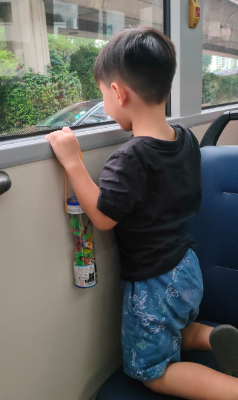
Reliving Childhood Wonder on the bus journey
Close your eyes and picture yourself as a child, climbing the stairs onto the upper deck of a double-decker bus. You’d almost always race to the front row—there was something magical about that vantage point. But what made it so irresistible?
Framing the Research
As UX researchers exploring Singapore’s public transport experience, we set out to understand commuter seating choices on our iconic double-deckers. To kick things off, I posed two simple questions to my own child, eager for unfiltered insight:
- Why head straight to the upper deck?
- Why always pick the seats all the way at the back?
My Child’s Honest Answer: “Because I can see everything.”
Singapore’s public buses and bus stations have continually evolved to become more inclusive for commuters requiring mobility assistance. The system adapts to shifting transportation trends and population needs. Despite these upgrades, many users still express frustration over perceived long waiting times, safety concerns, and overall comfort. We view these pain points as an opportunity to enhance the bus-commuting experience for families.
Project Overview
Over seven weeks, our four-person team applied the Design Thinking methodology to reimagine a family-friendly bus commute. This report outlines how we:
- Deepened our understanding of commuter behaviors
- Scoped the key problems affecting comfort and satisfaction
- Designed and iterated on potential solutions
Stage 1: Empathise
Field Observations
To build genuine empathy, each team member rode public buses and documented every step of the journey—actions, thoughts, and emotions. We repeated this exercise by shadowing another commuter end-to-end, ensuring our insights reflected diverse perspectives.
Empathy Mapping
Our research culminated in an aggregated empathy map, organized into four quadrants:
- Say — Direct quotes and remarks from commuters
- Think — Underlying thoughts and mental models
- Does — Observable actions during boarding, riding, and alighting
- Feel — Emotions expressed through body language and tone
The empathy map helped us consolidate behaviors and attitudes onto a single canvas. We then grouped findings into thematic clusters, with the most critical issues highlighted by a higher volume of Post-it notes.
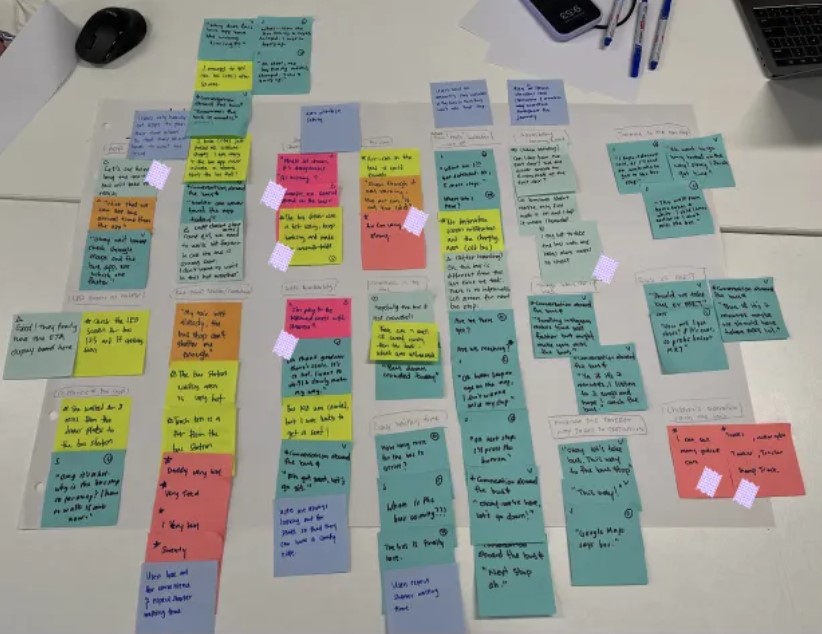
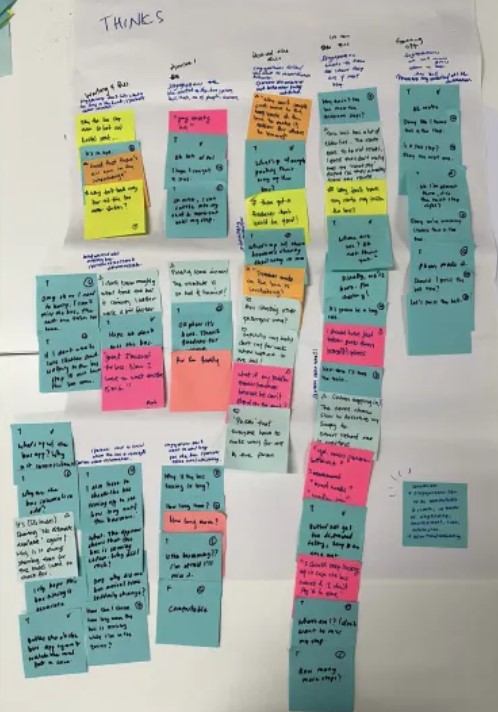
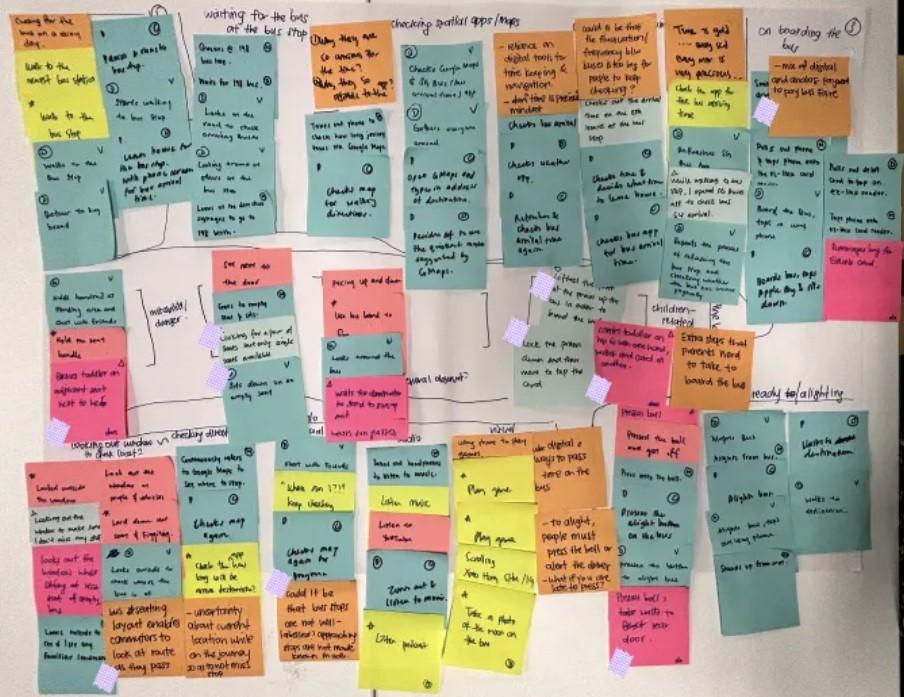
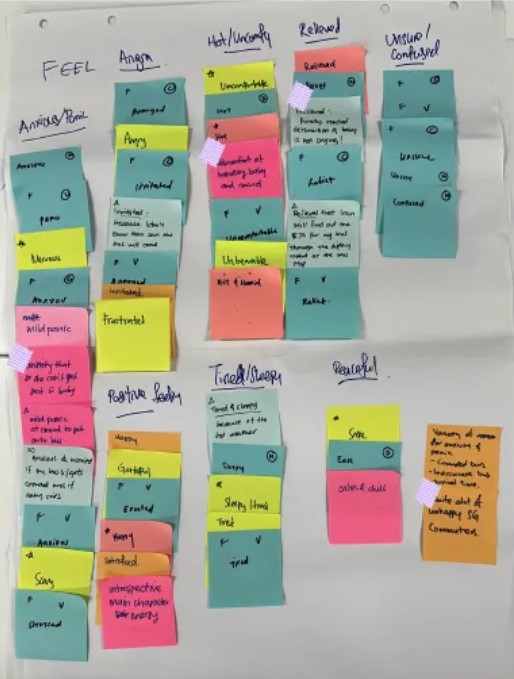
Key Insights from Fieldwork and Empathy Mapping
Over seven weeks of riding buses and shadowing commuters, we uncovered six core takeaways that will guide our next design phases:
- Time Efficiency & Reliability
Commuters prize accurate arrival times and swift service. Long waits lead to restlessness, especially when mobile apps or signposts mislead them about bus schedules. - More Than A Ride
The bus journey doubles as a brief respite from daily stress. Whether it’s gazing out the window, playing mobile games, or simply enjoying the air-conditioning, users leverage the commute for relaxation. - Accessibility Trade-offs
Though there’s dedicated space for strollers and personal mobility aids (PMAs), wheelchairs often take priority. Parents must fold strollers when space is limited, adding friction to their journey. - Children’s Perspective
Young riders view the bus through a lens of novelty and curiosity. They instinctively move toward windows—sometimes even standing on seats—to see outside, which raises safety concerns. - Safety & Comfort for Families
Parents juggling strollers, diaper bags, and restless toddlers face challenges in securing safe seating. The lack of clear guidance on stroller placement can inconvenience others and heighten parental anxiety. - Fear of Inconveniencing Others
Singapore’s “don’t inconvenience” culture can make parents reluctant to ask for help or space. Worrying about disturbing fellow commuters compounds their stress.
Opportunity: Designing for Parents with Young Children
While public transport has become more inclusive for wheelchair users and seniors, parents of children under four often fall through the cracks. Managing strollers and child-minding gear on a crowded bus is an uphill task—one echoed by first-time parents in our interviews.
Is this segment too niche to warrant solutions? If Singapore aims to uplift its fertility rates and champion inclusive design, making bus travel genuinely family-friendly should be part of our long-term urban strategy.
After all, as the former Second Transport Minister Ng Chee Meng proclaimed during the Transport Ministry’s Budget debate in Parliament in 2017:
“The future transport system will be more inclusive and must be designed “thoughtfully” to serve the needs of those with disabilities, families with young children and the elderly.”
Stage 2: Define
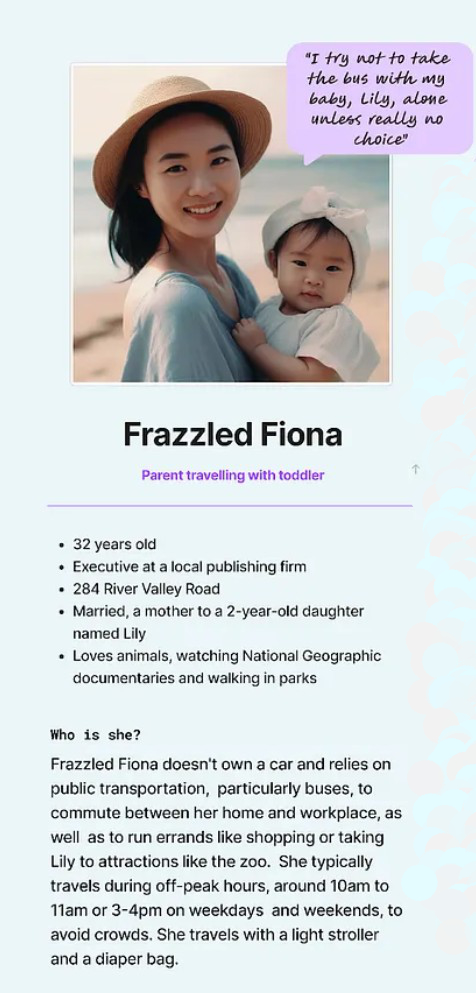
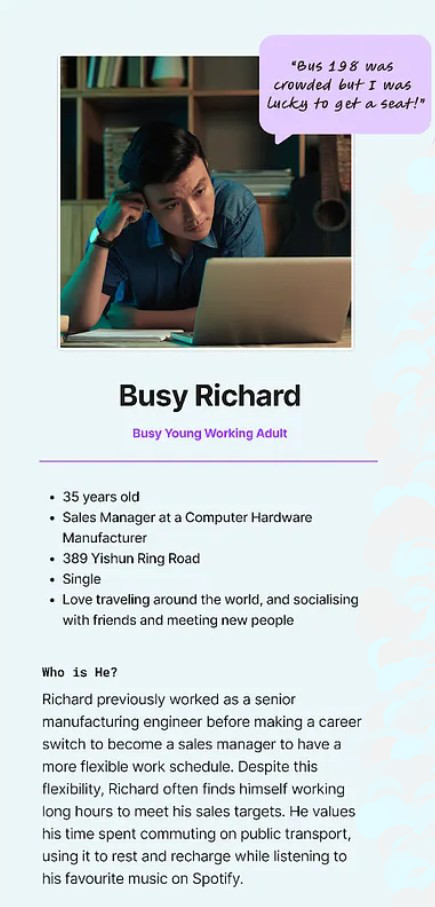
With our six key takeaways in hand, we honed in on two target personas and mapped their end-to-end bus journeys. These artifacts ensure our solutions stay laser-focused on real user needs, goals, and pain points.
Strengths of Your Approach
Sharp Focus: Narrowing to bus commutes and prioritizing Fiona’s top needs (especially safety) aligns perfectly with your 7-week constraint.
Validated Problem Statement: Cross-referencing with parents ensures your “safety + welcoming” focus addresses real pain points.
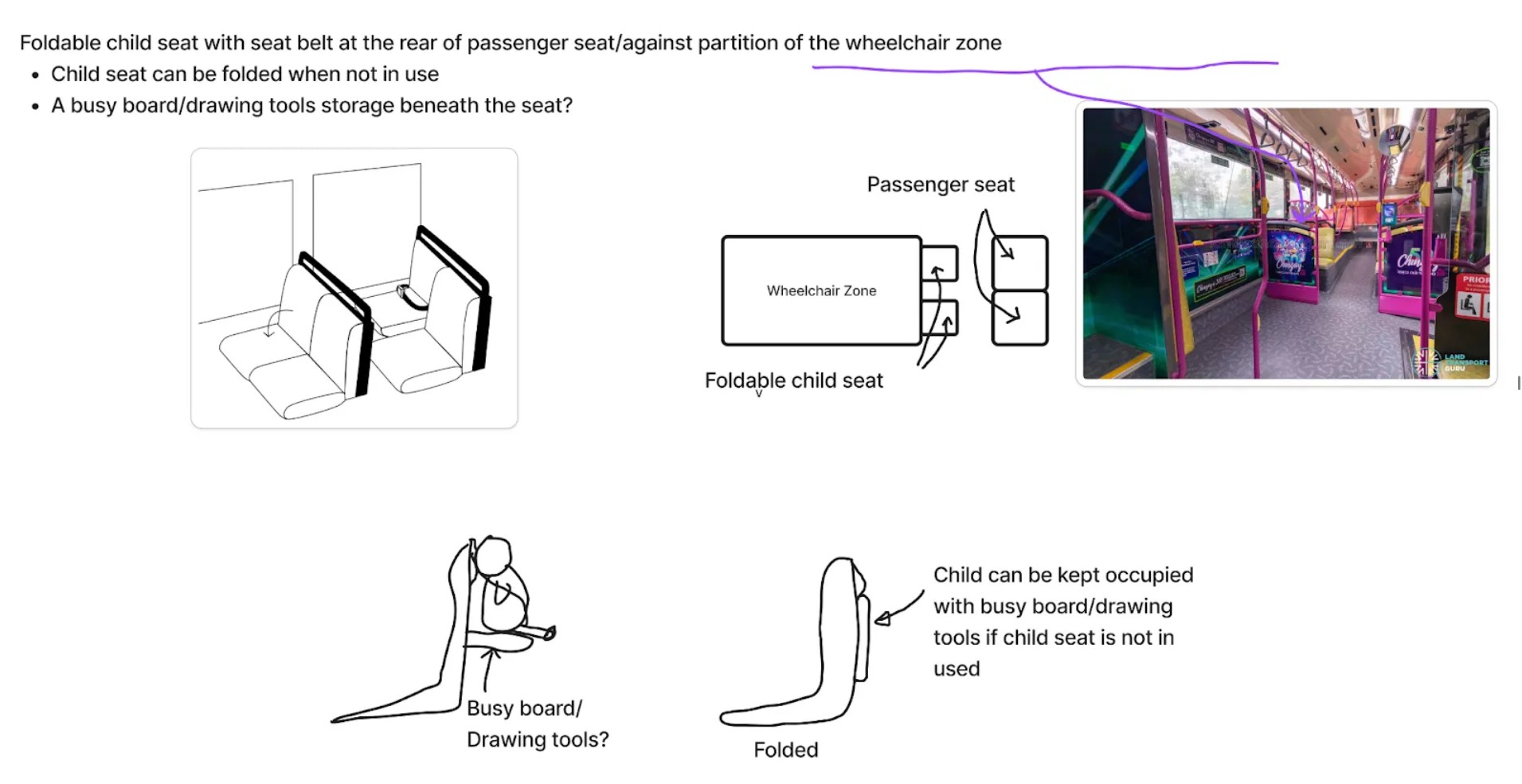
Prototype Relevance: The booster seat directly tackles the #1 need (safety) while subtly supporting comfort (child visibility) and efficiency (flip-up design saves space).
These personas and journey maps form the bedrock of our ideation. Next up: storming solutions that turn each “opportunity” into delightful, family-friendly features.
Creating detailed personas and customer journey maps grounded us in real-world parent experiences. We chose to centre our work on Frazzled Fiona, whose challenges mirror those of one of our teammates. Focusing on a single primary persona let us dive deeper and iterate more thoughtfully.
Boarding the Bus
- Fiona feels self-conscious unfolding her stroller and lugging a diaper bag through the aisle.
- She struggles to unbuckle Lily and settle her onto a seat or her lap before the bus moves off.
Settling In
- Fiona remains on high alert, bracing for sudden jerks that could jostle Lily.
- She fears Lily standing on the seat to reach the window, creating a safety hazard.
During the Commute
- Lily fusses when she can’t see outside, rattling Fiona’s nerves.
- The constant need to soothe and watch Lily prevents Fiona from relaxing on the ride.
Broader Insights on Family Travel
When parents travel with children aged 1–4, they face two uncomfortable choices:
- Child on Parent’s Lap
The child isn’t secured, and the parent can’t use both hands—compromising safety and comfort. - Child in Their Own Seat
Young children often stand or kneel on seats to peek out windows, increasing the risk of injury.
These scenarios not only heighten parental anxiety about safety but also amplify the feeling of inconveniencing fellow commuters. Addressing these overlapping pain points is essential for designing a truly family-friendly bus experience.
Stage 3: Ideate
With a clear focus on Frazzled Fiona, we kicked off a broad brainstorming session before narrowing in on the most promising directions. Every idea had to speak directly to her pain points—no detours.
From 10 to 5: Crafting How-Might-We Statements
- We each wrote ten HMW statements on Post-its, aiming to capture Fiona’s boarding, riding, and disembarking struggles.
- Using dot-voting, the team surfaced the statements that best balanced clarity of problem and openness to solution.
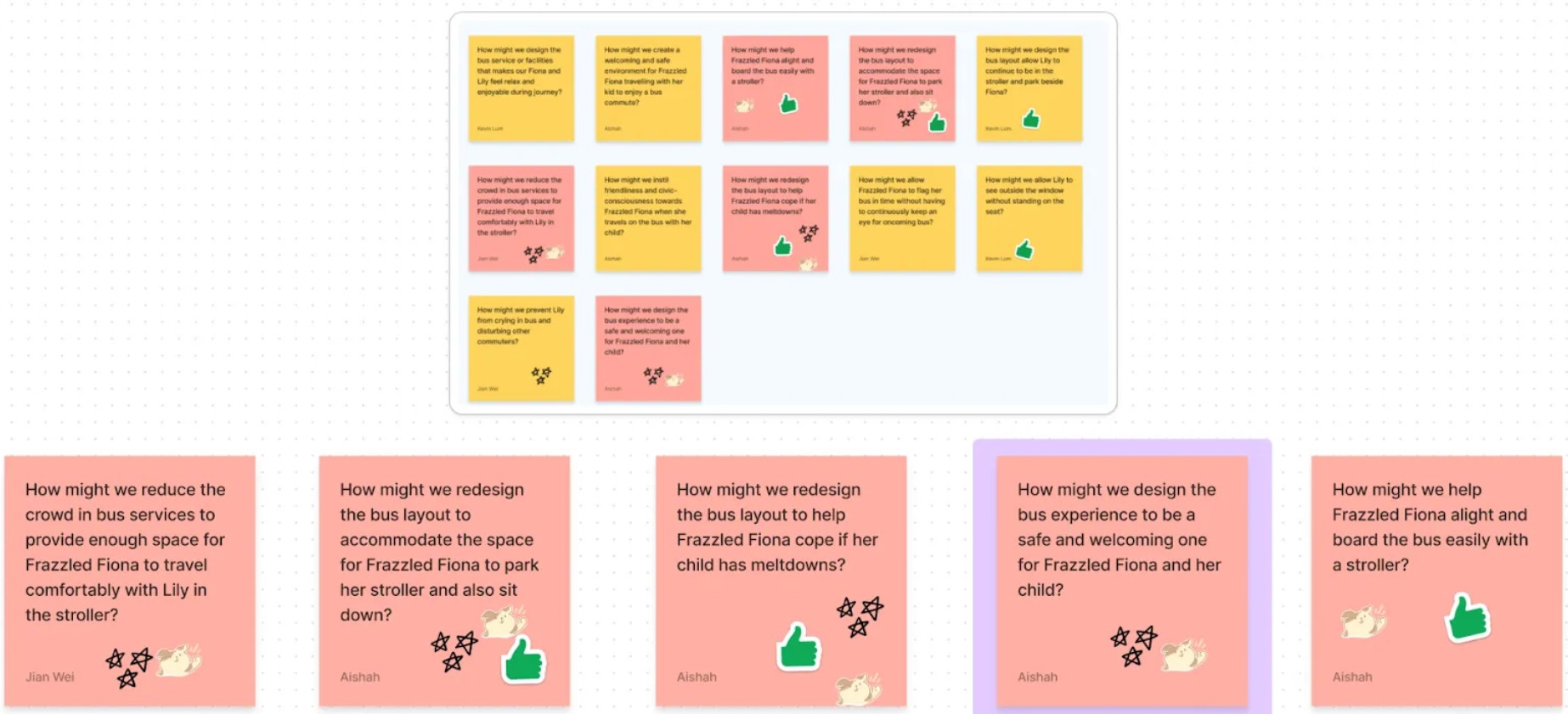
Our Top How-Might-We Statements
- How might we reduce the crowd in bus services to provide enough space for Frazzled Fiona to travel comfortably with Lily in the stroller
- How might we redesign the bus layout to accommodate the space for Frazzled Fiona to park her stroller and also sit down?
- How might we redesign the bus layout to help Frazzled Fiona cope if her child has meltdowns?
- How might we design the bus experience to be a safe and welcoming one for Frazzled Fiona and her child?
- How might we help Frazzled Fiona alight and board the bus easily with a stroller?
💡Ideate & Converge
We kicked off with one golden rule: generate as many ideas as possible without worrying about feasibility. From our five shortlisted HMW statements, we brainstormed 10 solution-driven concepts each—50 in total—to spark creative directions that directly address Frazzled Fiona’s
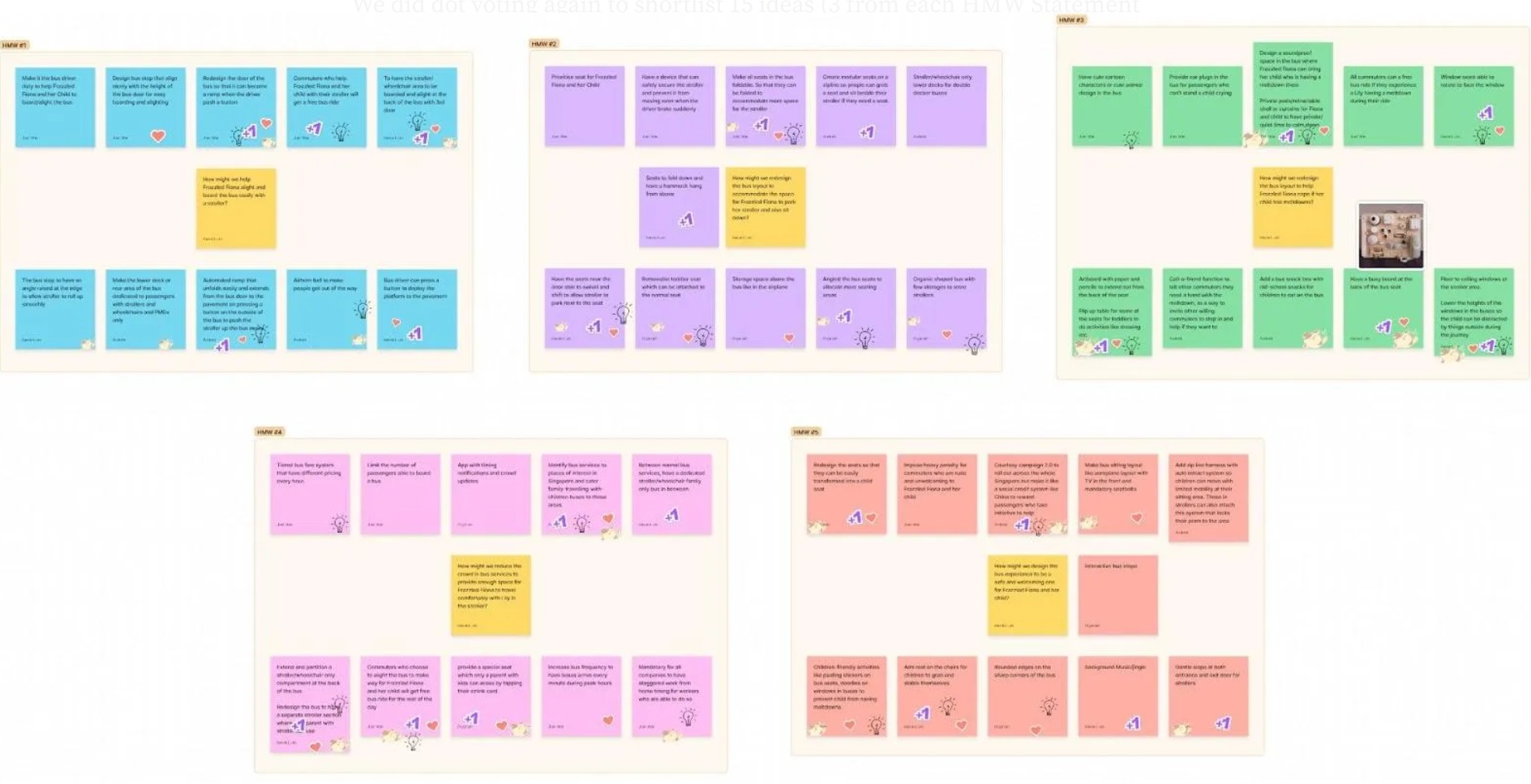
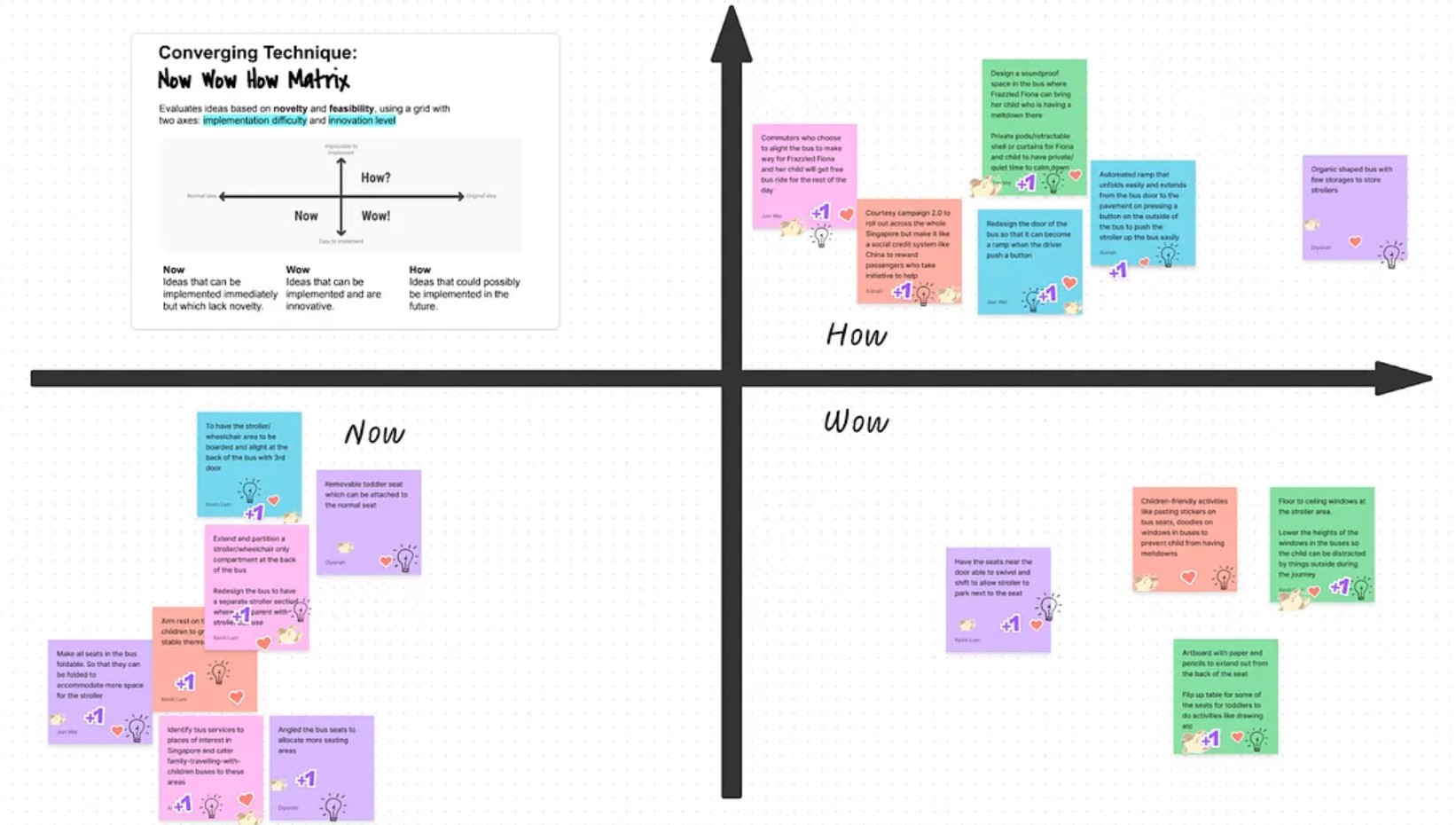
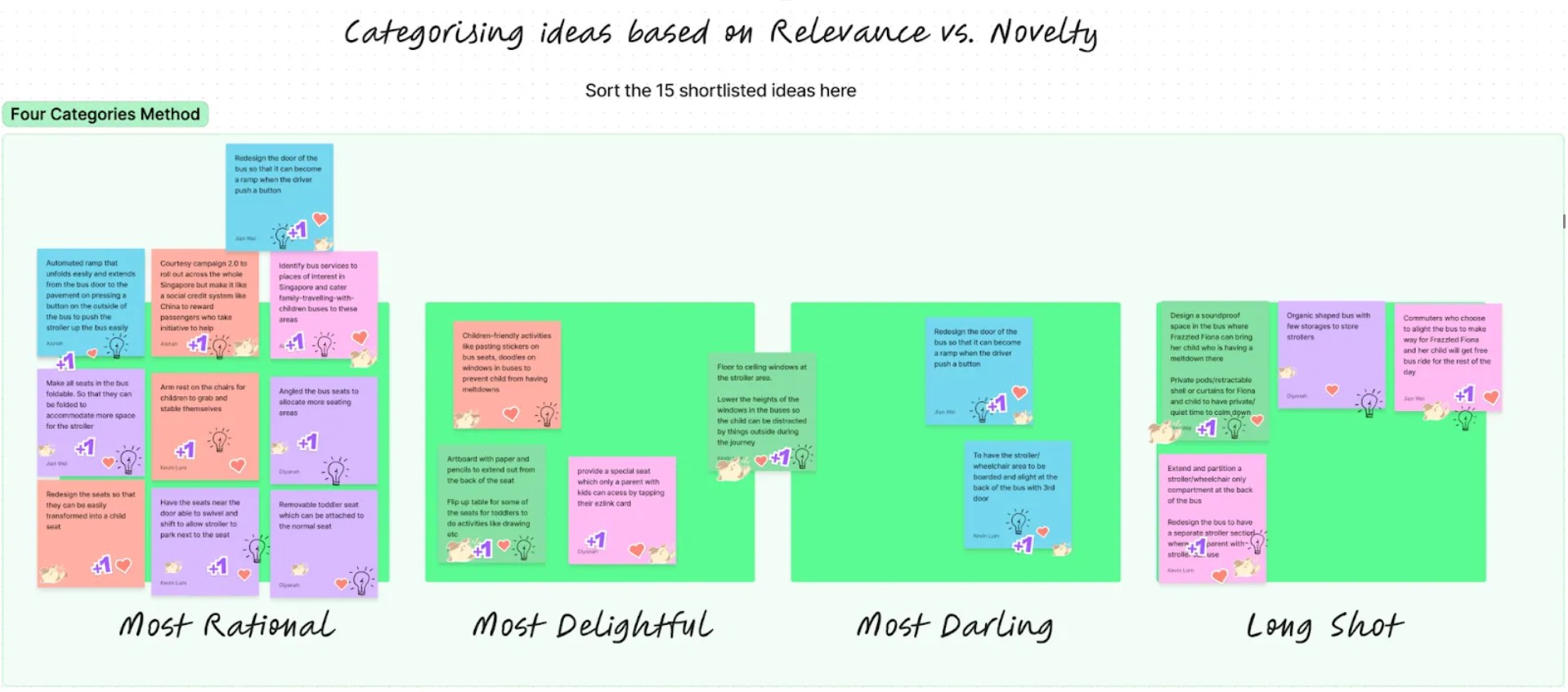
After our initial brainstorming and dot-voting, we narrowed 50 ideas down to 15 finalists (three per HMW). We then applied two complementary evaluation frameworks—Now-How-Wow and Four Categories—to identify concepts worth prototyping.
The Four Categories method sorts ideas into the following superlatives: rational, delightful, darling, and long-shot.
Prototyping Candidates
From our convergence exercise, we selected five ideas—each tied to a How-Might-We statement—to move into prototyping. These concepts directly address Frazzled Fiona’s top pain points and set the stage for low-fidelity mockups and user feedback
1. Boarding & Alighting with a Stroller
HMW: How might we help Frazzled Fiona alight and board the bus easily with a stroller?
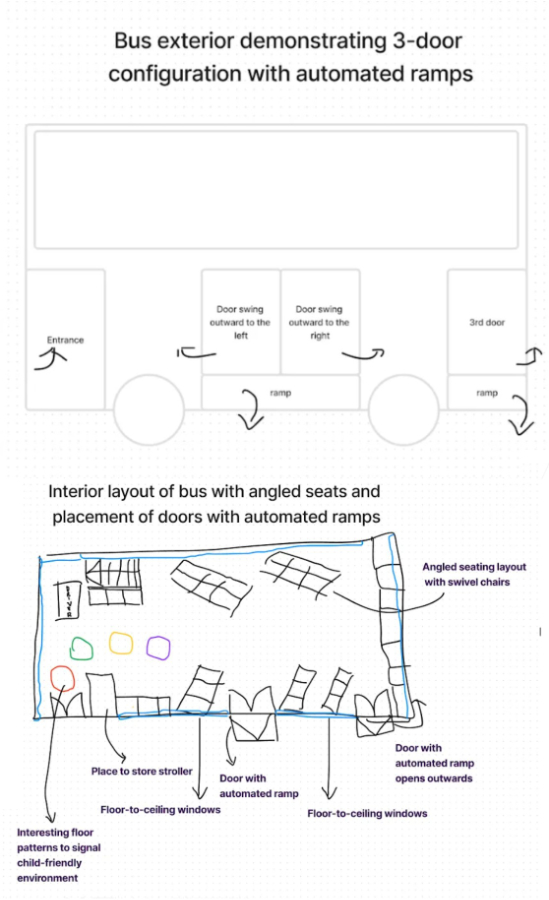
- 💡A redesign of the bus doors to accommodate an automatic ramp that deploys and retracts at the push of a button from the bus captain’s cockpit.
2. Flexible Stroller Parking & Seating
HMW: How might we redesign the bus layout to accommodate the space for Frazzled Fiona to park her stroller and also sit down?
- 💡 Angled and swivel bus seating configuration to allocate more creative use of bus space, and hopefully accommodate more space for strollers and wheelchairs at the same time
3. Safe & Welcoming Environment
HMW: How might we design the bus experience to be a safe and welcoming one for Frazzled Fiona and her child?
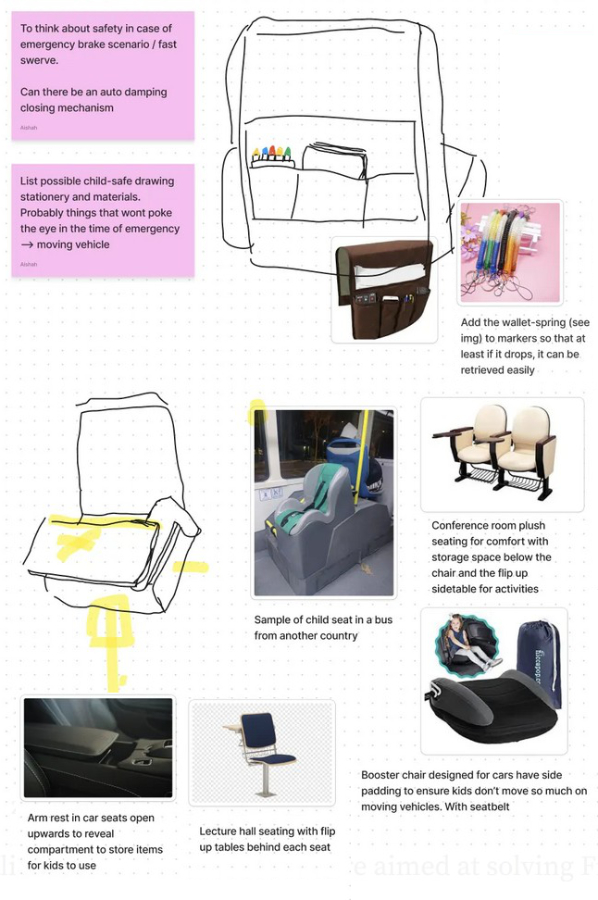
- 💡 Attaching armrest on bus seats for children to hold on to and steady themselves on a moving bus
4. Managing Child Meltdowns
HMW: How might we redesign the bus layout to help Frazzled Fiona cope if her child has meltdowns?
- 💡 Floor to ceiling windows for buses or lower the height of the windows of the buses to a kid-friendly height
- 💡Artboard with paper and pencils to extend out from the back of the seat. Flip up a table for some of the seats to occupy children with activities
Next, we’ll build low-fidelity versions of each concept and conduct usability sessions with parents like Fiona.
Stage #4 — Prototype
Stage #5 — Testing
We talk to parents and children
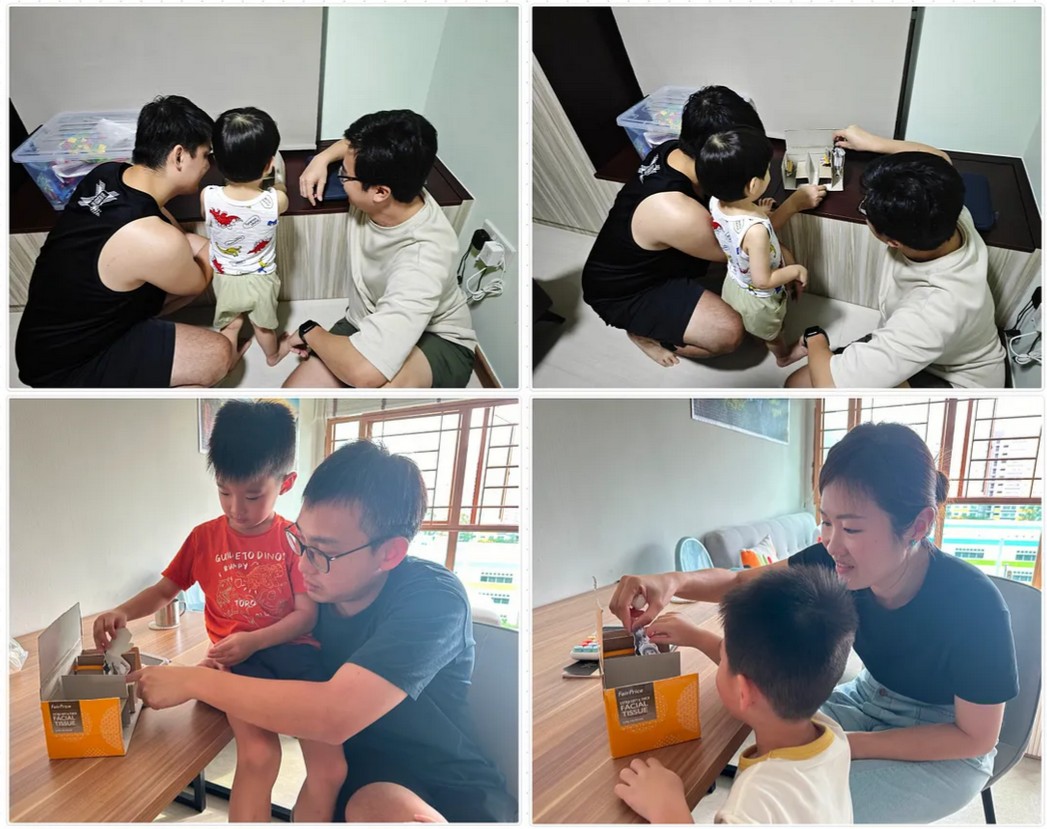
With our prototypes done, we moved on to the testing stage. We spoke to a total of 8 parents and their respective children of ages between 2 to 5. While Frazzled Fiona, the parent, is our primary user persona, it is also beneficial to speak with the children. This provides additional insights into the prototypes’ usability, as they are the secondary users. To ensure the tests are standardized as much as possible, we followed a script and a list of questions to ask the subjects during tests.
Test Procedure —
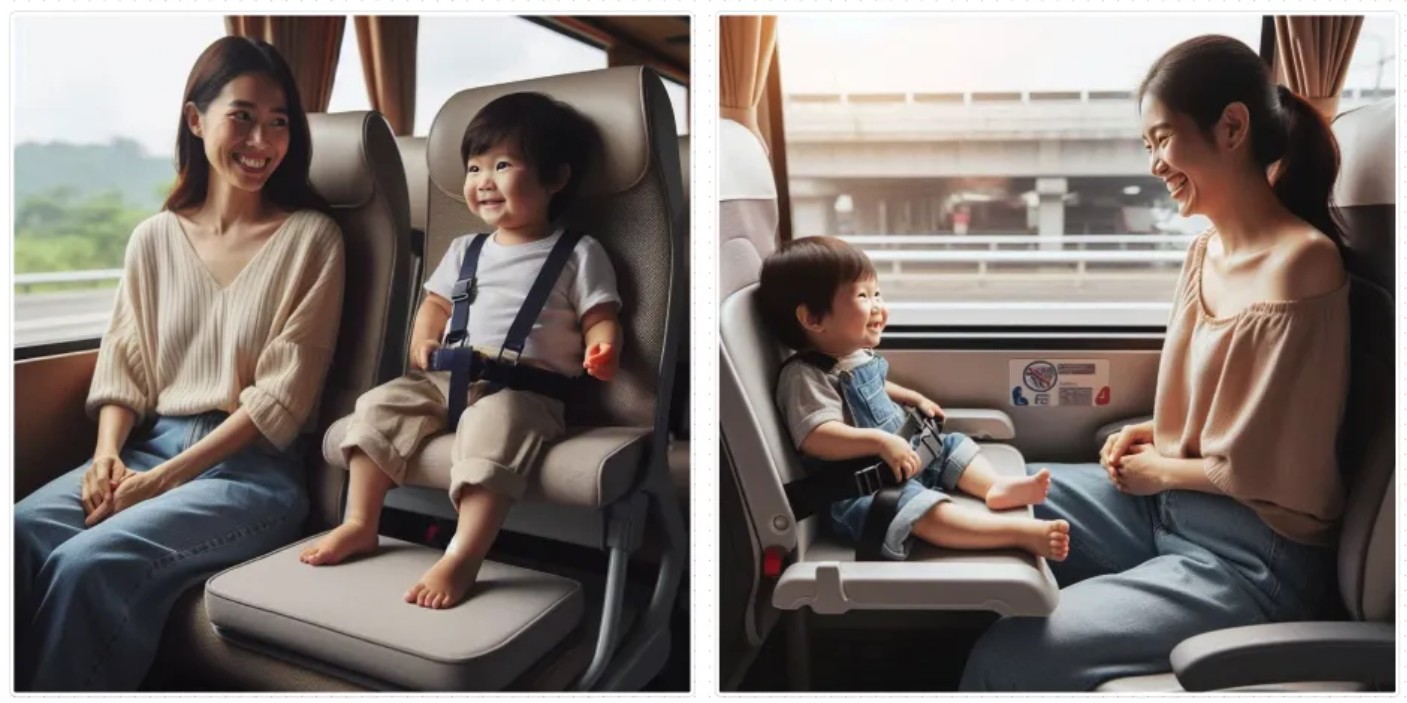
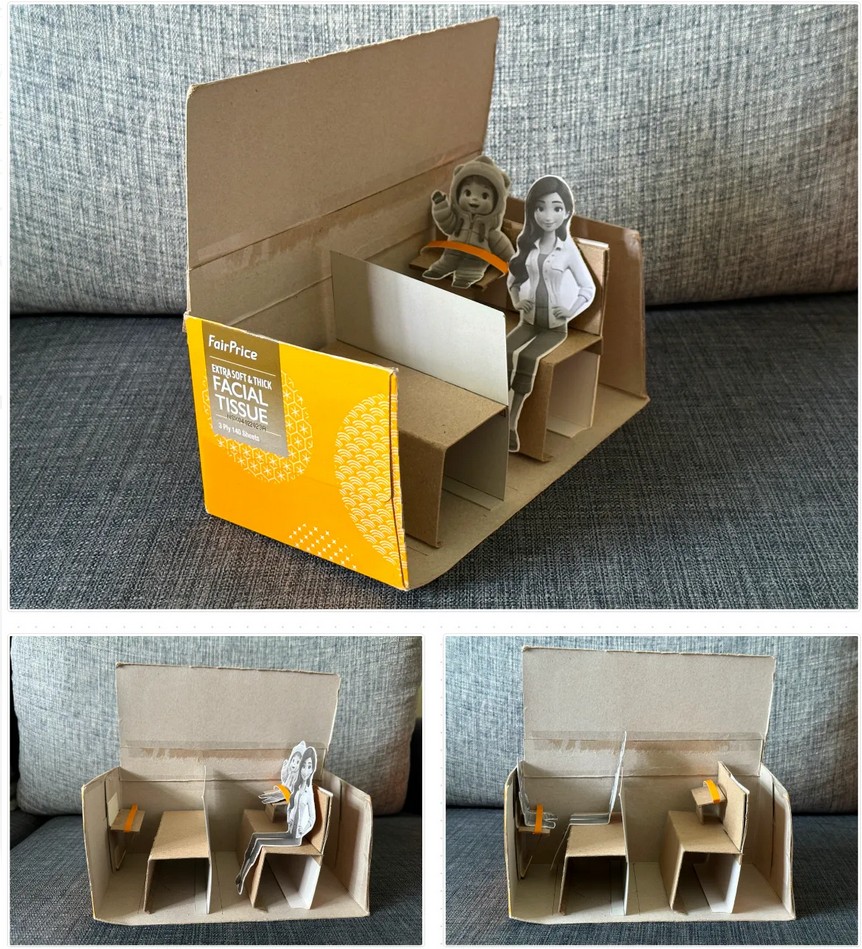
- Show the user the cardboard prototype of the 2 configurations of the child booster seats and the image set of seat designs.
- Explain to the user how the different seat configurations work
- Provide the user with a cardboard cut-out of a parent and child, and get the user to place the parent and child cut-out into their preferred seating configuration.
Key Learnings
Rear-Facing Configuration is Superior
-
-
Safety Validation: Confirmed by research (Durocher, 2023; Anderson & Peterson, 2023), rear-facing seats significantly reduce spinal/neck injury risks during collisions.
-
Parent-Child Bonding: Face-to-face interaction improves monitoring and emotional connection (“I can manage my child better“).
-
Multifunctional Design: Doubles as a table when the child sits on the parent’s lap.
-
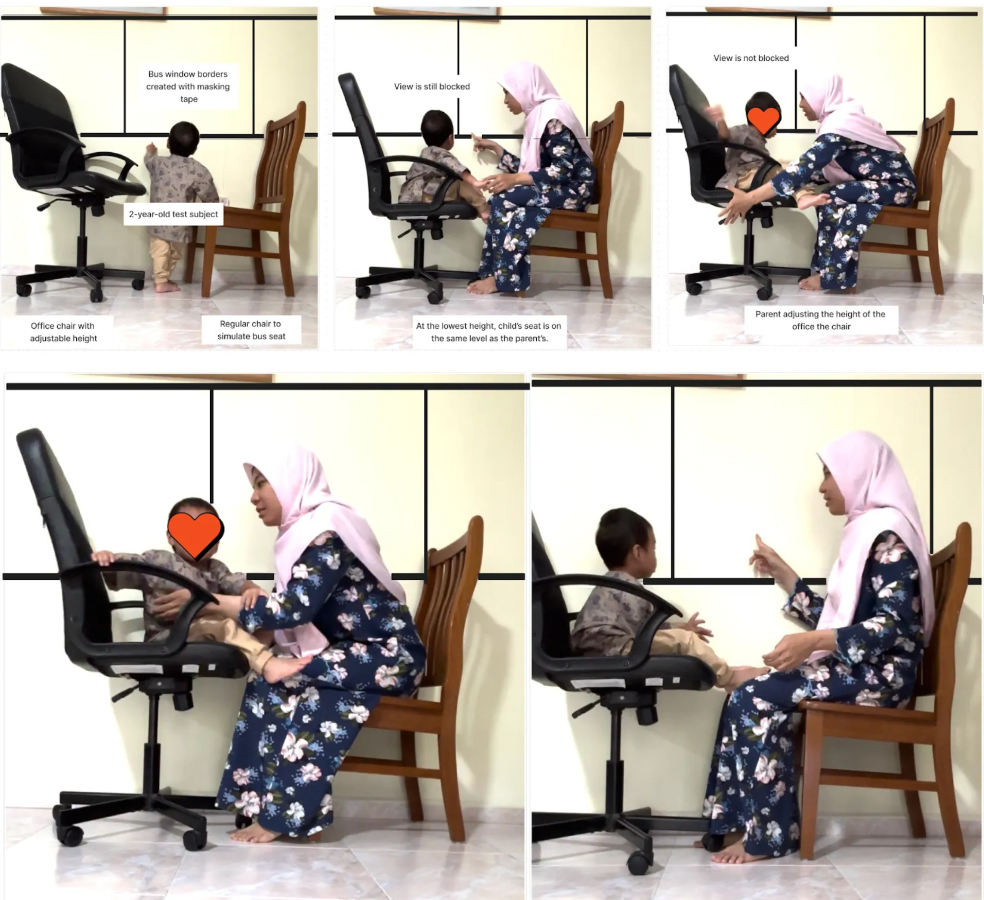
Height Adjustment is Critical for Engagement
-
-
Child Engagement: Elevated seating enables effortless window views, keeping children calm and occupied (“They don’t have to exert effort to see outside“).
-
Parent Comfort: Higher child seats free up parental legroom and improve maneuverability.
-
Window Access Drives Child Satisfaction
-
-
Children consistently gravitated toward window views. Future bus designs should prioritize lower window sills or adjustable seats to align with children’s sightlines.
-
Safety + Engagement = “Welcoming” Experience
-
-
The booster seat directly addressed Fiona’s top need (safety) while indirectly fulfilling:
-
Entertainment: Window views prevent meltdowns.
-
Emotional Comfort: Proximity reduces parental anxiety.
-
Efficiency: Easy monitoring minimizes disruptions.
-
-